
Monkey Massacre in Mauritius — the island's hidden trade in lab monkeys
Mauritius sells itself as paradise. Behind the beaches, thousands of long-tailed macaques are trapped, caged on breeding farms and flown to laboratories in the US and Europe every year.
The Monkey Massacre in Mauritius movement is a local and international campaign fighting to end the capture, breeding and export of these monkeys for biomedical testing. The Coalition for Cruelty Free Africa (CFCFA) stands with it.
The species is endangered. The trade is legal. And most visitors to Mauritius have no idea it exists.

The scale of the Mauritius monkey trade
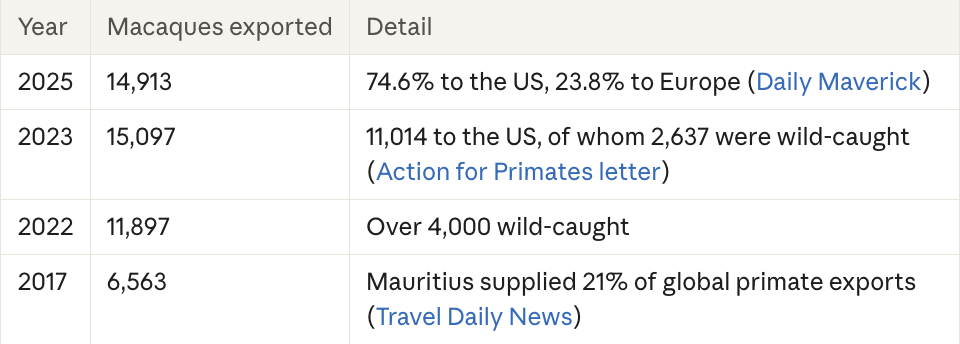
Mauritius is one of the world's biggest suppliers of monkeys to labs, and exports have more than doubled since 2017.
Worldwide, 40,646 long-tailed macaques were traded in 2024.
A single macaque can sell to a US lab for around R1 million (roughly US$55,000).
Monkeys are less than 2% of Mauritian export income — a fraction of what tourism earns.
The Organisations responsible for the mass killings
Five companies run the Mauritius macaque industry: Charles River Laboratories (US), Biosphere Trading (China), Biolink Ltd, LCL Cynologics Ltd and Bioculture Mauritius (Daily Maverick).
Charles River Laboratories is the largest buyer of Mauritian monkeys. In 2025 the government signed an MOU allowing it to run pre-clinical testing on the island itself (Action for Primates).
Bioculture is one of the island's largest trappers, setting traps on private land. In 2021 it supplied 70% of Mauritian macaques sent to the US (Pulitzer Center).
Airlines carry the monkeys. Kenya Airways ended its monkey transport deal after a truck of Mauritian macaques crashed in Pennsylvania in 2022 (Nation); PETA reports EgyptAir has since flown shipments to New York.